

The Smooth Ride: Global Two-Wheeler Suspension System Market to Hit USD 2.90 Billion by 2035
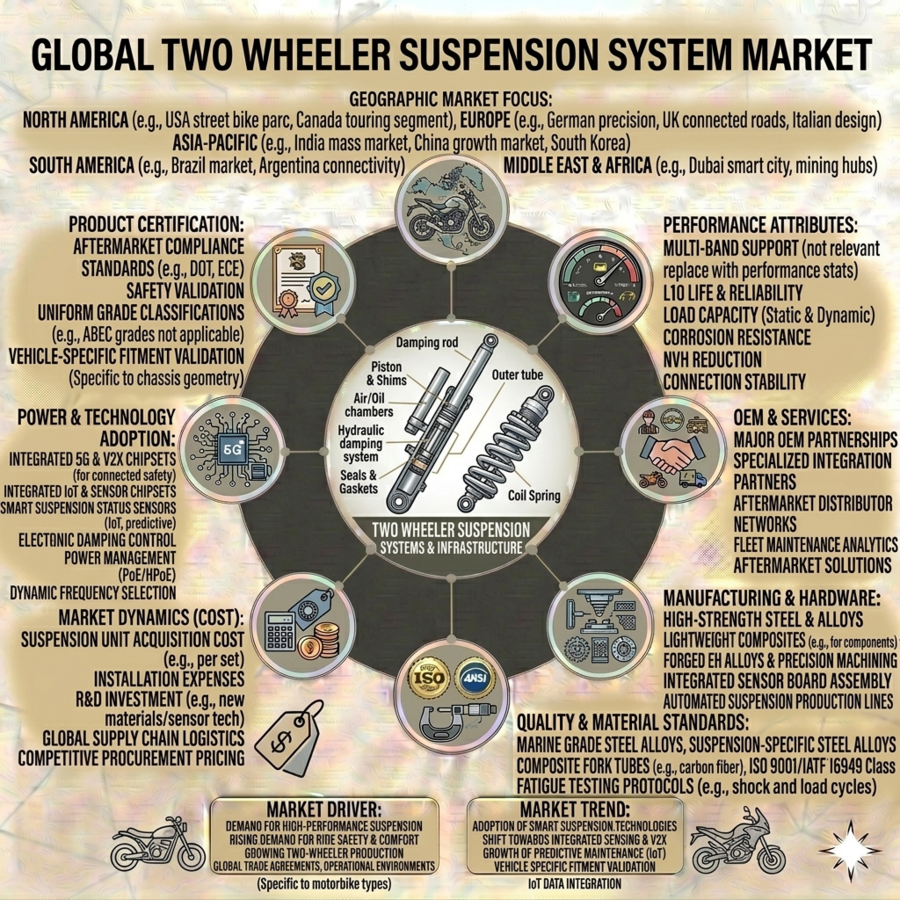
Two Wheeler Suspension System Market
The Two Wheeler Suspension System Market is expected to grow from USD 1.8 billion in 2025 to USD 2.90 billion in 2035, reflecting a CAGR of 4.9%.
NEWARK, DE, UNITED STATES, April 1, 2026 /EINPresswire.com/ -- As global urbanization accelerates and the demand for premium commuting experiences rises, the components responsible for rider comfort and safety are seeing a significant valuation boost. According to the latest 2025 strategic analysis, the Global Two-Wheeler Suspension System Market is valued at USD 1.8 billion in 2025 and is projected to reach USD 2.90 billion by 2035, expanding at a steady CAGR of 4.9%.
The market is currently transitioning from basic mechanical springs to "smart" damping solutions. This evolution is driven by the rise of high-performance electric motorcycles and a growing middle class in Asia-Pacific that prioritizes ride quality over mere utility.
Core Segments: Telescopic Dominance and OEM Integration
The market is defined by a heavy reliance on proven mechanical architectures and direct supply relationships with vehicle manufacturers.
• Telescopic Front Suspension (54.7% Share): This remains the industry standard due to its unmatched balance of reliability and cost-effectiveness. Its simple construction and ease of maintenance make it the go-to choice for the hundreds of millions of commuter motorcycles and scooters produced annually in emerging markets.
• OEM Direct Supply (63.2% Share): The vast majority of market value is generated through direct partnerships between suspension specialists and vehicle brands. Because suspension geometry is fundamental to a vehicle's frame design, manufacturers prefer long-term, integrated development cycles with trusted suppliers like Showa or KYB.
• Motorcycles (58.6% Share): While scooters are popular for urban mobility, motorcycles—ranging from economy commuters to high-end superbikes—remain the dominant vehicle segment, requiring more diverse and sophisticated suspension setups to handle varying terrains and speeds.
Get Access of Report Sample:
https://www.futuremarketinsights.com/reports/sample/rep-gb-12780
Growth Drivers: Electrification and Premiumization
Three major shifts are propelling the market forward:
1. The EV Transition: Electric two-wheelers (E2Ws) present a unique engineering challenge. The heavy mass of battery packs requires revised suspension geometry and damping rates to manage a different center of gravity and the instant torque delivery of electric motors.
2. Premiumization in Emerging Markets: In countries like India and Indonesia, there is a marked shift toward mid-range and premium motorcycles. This has increased the adoption of Inverted Front Forks (USD/Upside Down forks) and Mono Shock rear units, which offer superior handling and aesthetics compared to traditional twin-shock setups.
3. Smart Damping Technologies: High-end models are increasingly featuring electronically controlled suspension systems that monitor road conditions in real-time and adjust damping automatically, a trend trickling down from luxury automobiles to the two-wheeler world.
Regional Powerhouses: Asia-Pacific and the German Tech Hub
The global two-wheeler suspension system market is characterized by distinct regional growth drivers and specialized industrial focuses. Germany leads the pack with a projected 7.1% CAGR, fueled by its leadership in premium motorcycle engineering—most notably through BMW Motorrad—and a robust appetite for high-performance aftermarket upgrades. India follows closely with a 6.3% CAGR, driven by a massive domestic shift toward premium commuter brands and the rapid expansion of mid-segment motorcycle production.
Japan remains a central hub with a 6.2% CAGR, leveraging its status as the home of global suspension giants and its focus on high-precision, electronically controlled damping systems. In China, a 5.4% CAGR is supported by its position as the world's largest producer of electric scooters, which generates massive demand for lightweight and energy-efficient suspension components. Meanwhile, the United States is forecasted to grow at a 4.8% CAGR, sustained by a strong culture of vehicle customization and a high-value market for heavy-duty cruiser and adventure touring suspensions.
Competitive Landscape: The Masters of Damping
The market is led by highly specialized engineering firms that dominate both the factory floor and the racing circuit:
• Showa Corporation (Hitachi Astemo): A global leader known for its deep integration with major Japanese OEMs and its presence in professional racing.
• Gabriel India Limited & Endurance Technologies: Key players in the high-volume Indian market, focused on localized, cost-effective manufacturing at a massive scale.
• KYB Corporation: Renowned for high-precision hydraulic technology and a diverse portfolio spanning all vehicle segments.
• Öhlins & WP Suspension: The "gold standard" for premium and racing applications, focusing on high-margin, adjustable, and semi-active suspension systems.
Frequently Asked Questions (FAQ)
1. Why is the "Telescopic" fork still so dominant after decades?
It is a "solved" technology. It is inexpensive to manufacture, incredibly durable in dusty or harsh environments, and can be serviced by almost any mechanic worldwide. For the mass-market commuter segment, its performance-to-cost ratio is unbeatable.
2. What is the difference between an Inverted Fork (USD) and a Standard Fork?
In an inverted fork, the thicker part of the fork is at the top, clamped into the triple trees. This makes the front end stiffer and more resistant to flexing during hard braking or cornering, which is why they are preferred for performance motorcycles.
3. Do electric scooters need special suspension?
Yes. Because batteries are heavy and usually placed low or near the rear wheel, the suspension must be tuned to handle different weight distributions and "sprung vs. unsprung" mass ratios to ensure the ride isn't too harsh or bouncy.
4. How does a Mono Shock differ from Twin Shocks?
A Mono Shock uses a single, larger shock absorber, usually centrally located. It often provides a more progressive damping feel and allows for a more centralized mass, which improves the bike's flickability and overall handling compared to older twin-shock designs.
5. Is the aftermarket for suspension significant?
Yes, it accounts for roughly 29% of the market. Enthusiasts often upgrade their factory suspension to premium brands like Öhlins or Nitron to get better adjustability for track days, touring, or off-road adventures.
Browse More Industry Reports :
Two Wheeler Fuel Injection System Market
https://www.futuremarketinsights.com/reports/two-wheeler-fuel-injection-system-market
Two Wheeler Anti-lock Braking System Market
https://www.futuremarketinsights.com/reports/two-wheeler-anti-lock-braking-system-market
Two-Wheeler Aftermarket Components & Consumables Market
https://www.futuremarketinsights.com/reports/two-wheeler-aftermarket-components-market
Sudip Saha
Future Market Insights Inc.
+1 347-918-3531
email us here
Legal Disclaimer:
EIN Presswire provides this news content "as is" without warranty of any kind. We do not accept any responsibility or liability for the accuracy, content, images, videos, licenses, completeness, legality, or reliability of the information contained in this article. If you have any complaints or copyright issues related to this article, kindly contact the author above.
